Update on Baby Whose Head Was Cracked Like an Egg Shell by Father
Books
The Fine art of Hatching an Egg, Explained
Author Tim Birkhead is at it again—this time with a written history of eggs and the wonders that lie inside.
Excerpted from THE MOST PERFECT THING: INSIDE (AND Outside) A BIRD'Southward EGG . Used with the permission of the publisher, Bloomsbury. Published April 2016. Copyright © 2016 past Tim Birkhead. All rights reserved.
What makes a bird egg so spectacular? That's the driving question backside Tim Birkhead's latest non-fiction masterpiece, The Most Perfect Matter, released this past jump. From the making and coloring of shells to the self-sanitizing power of a parent'southward affect, Birkhead lays bare the unabridged history of the egg and its survival. In the following extract of a chapter, the author digs into the debate on which end of the egg comes first, before carrying off into a rich description of the chick'due south emergence from its incubated labratory, out into the big and cute earth.
* * *
In Gulliver'southward Travels, Jonathan Swift describes a conflict between different factions inside the kingdom of Lilliput over which end a boiled egg should be broken.
Past tradition the Lilliputians had always cleaved their eggs at the big end, merely afterwards the Emperor cutting himself while opening the large terminate, he decreed that the little end should be the cease for opening. This was not universally accustomed and the quarrels over which finish was opened gave ascent to no fewer than six rebellions. Swift'southward endian wrangle satirises the ongoing eighteenth-century conflict between the Catholics (big-endians) and the Protestants (little-endians) over whether the body of Christ is actually or only symbolically present in the Host at communion.
There has been a similar endian dispute over which way an egg emerges from the bird'due south cloaca: big finish or fiddling end first? Although there are some dissenters, most people—thanks largely to Aristotle—call back that the edgeless end emerges first. In turn this has led to an erroneous caption for how the egg is propelled along the oviduct. Several early authors, including Friedrich Christian Günther, who wrote 1 of the first books on birds' eggs in the 1770s, assumed that because the blunt cease emerged first that is how the egg travels downwards the oviduct. He suggested that information technology is pushed forth by peristaltic forces, much like a food bolus in the gut, with the oviduct'south round muscles contracting behind the egg while those at the front are relaxed. Information technology was thought that the abaft, pointed cease—that is the longer portion of the egg—gave the oviduct wall greater purchase to clasp the egg on its way.
One of the proponents of this idea, the nineteenth-century anatomist Heinrich Meckel von Hemsbach, was so confident about this explanation he chosen it a "mathematical necessity." To be fair, the idea does take an intuitive appeal, which probably explains why it was picked up and perpetuated by the swell Scottish biologist D'Arcy Wentworth Thompson in his volume On Growth and Form (1917). Thompson's intellectual stature was such that others causeless he must be right, including J. Arthur Thomson who repeated the fault in his Biology of Birds published in 1923.
I am intrigued by the style sure ideas in biology tin can persist for so long in the confront of contradictory evidence. How could D'Arcy Thompson, J. Arthur Thomson and others, ignore the bear witness that flew in the confront of their egg motility thought? Every bit early every bit the 1820s two monumetal figures in biology, the Czech biologist January Purkinje and the German Karl Ernst von Baer, both reported that even though the hen's egg unremarkably emerges blunt cease first, information technology passes downwardly the oviduct pointed end first. Others confirmed that this was also truthful for pigeons, hawks and canaries, so why did Thompson and Thomson persist in their contrary view? Did they non believe their illustrious predecessors? Perhaps they didn't read German (for which they can be forgiven). The i paper that surely should have convinced them was by Heinrich Wickmann.
Using eight very tame chickens that would lay their eggs on his desk, Wickmann recorded the events in the hours immediately earlier and during egg laying. Ingeniously, he was able to utilise a pencil to mark that bit of the egg he could run into within the hen'southward oviduct, through its cloaca prior to laying. (I can merely imagine his wife popping into his study with a cup of coffee and seeing Wickmann with his pencil up a hen'southward bottom: "What are you doing, beloved?" she asks . . . ). This immune him to establish that, in the hour or so before it is laid, the egg is orientated with its pointed egg directed towards the bird'due south rear fifty-fifty though all eggs were all laid blunt end first. Wickmann deduced that the egg must plough immediately earlier it is laid.
When I first heard of eggs turning in this fashion I imagined them doing so vertically, forth their long axis—that is by "pitching"— but they actually practise and so by rotating through 180° in the horizontal plane (i.e. yawing). This was discovered in the 1940s by John Bradfield, who used Ten-rays to find hens' eggs on the subsequently part of their journey through the oviduct. The broody hens saturday immediately in forepart of the X-ray screen, and a succession of images was taken, starting at around midday just as the egg—covered simply by the shell membrane—entered the shell gland. Images were taken, Bradfield says, at intervals until 9 p.thousand. and and so restarted at 8 a.k. the next mean solar day. Had Bradfield been my PhD educatee I'd have suggested that he stay up all nighttime at least once, although equally it turned out information technology probably didn't matter. He wrote: "That part of shell secretion which goes on during the night is unavoidably missed, but by following an egg which is ovulated early in the twenty-four hours it is possible to trace the first half of the procedure (which proved to be the most interesting), together with the last few hours."
When Bradfield examined his Ten-ray images what he saw was remarkable. An hour or and so before laying, the shell gland with its fully formed shelled egg dropped a few centimetres out of the pelvic girdle, and over a menses of just ane or 2 minutes, during which the hen stood upwardly, the egg rotated 180° horizontally. The dropping of the shell gland is possible considering, different the mammalian pelvis which forms a circle of os and through which the head of the fetus must pass at birth, a bird's pelvis is, as Bradfied says, shaped similar an upturned gunkhole, allowing the drop and rotation to occur, besides as facilitating the laying of large, hard-shelled eggs.

In each bird that Bradfield observed, the pattern was the aforementioned: the egg entered the trounce gland pointed end first, turned and was laid blunt end first. Why turning should be necessary is unclear, specially for eggs like those of the domestic fowl and most passerines that don't actually differ all that much between ends. The fact that it isn't entirely consistent within species implies that the fashion the egg emerges cannot be that important. It is a pity that those researchers who observed the few chicken eggs laid pointed end first did not tape whether those eggs were a different shape from those laid blunt stop first. Perhaps for near eggs it is better—for some unknown reason—to undertake nearly of their journey downward the oviduct pointed end first, but for the finale to emerge blunt cease first is better.
* * *
Hatching is the climax of incubation; indeed, it is the climax of both fertilisation and incubation and the 3rd great landmark in the life of an egg. How does the chick interruption out from the claustrophobic confines of the trounce? Our mental image of the process has been corrupted by cartoons, where attempts to romanticise and sanitise the process often show a hen'south egg with its top neatly popping off to reveal a warm, yellow fluffy chick. The reality is not similar that. It is nonetheless pretty remarkable, but it isn't as quick, as clean, or as simple as nosotros accept sometimes been led to believe.
A fully developed embryo lies scrunched upward inside the egg with its ankles at the pointed terminate and its caput towards the blunt end; its neck is bent then that the head lies next to the breast with the beak poking out from under the correct wing upward confronting the egg membrane. This pre-hatching posture seems to be typical of all birds, except for megapodes.
Before starting to break out of the egg the chick has 3 things it must achieve. It must first switch from being dependent on the oxygen diffusing through the pores in the eggshell into the network of blood vessels that line the inner surface of the crush and start to apply its ain lungs to breathe. The chick takes its first proper breath and fills its lungs the moment it punctures the air jail cell inside the top of the egg. This step is essential because by this stage of development there is not enough oxygen diffusing through the pores in the beat to support the chick's respiratory requirements. Taking a breath from the air cell provides the oxygen and the energy necessary to break through the eggshell.
Before it takes that first breath, the chick has to starting time shutting off the blood supply to the network of blood vessels that line the inner surface of the beat out, and withdraw that blood into its body. The blood vessels are programmed to close off at the point where they emerge from the bird's umbilicus, and just before the chick starts cut round the shell.
Third, the chick has to take what is left of the yolk and draw information technology into its abdomen. Information technology does this past sucking up the remaining yolk through the stalk that connects the yolk to the chick's small-scale intestines. This "yolk sac" is a food reserve for the first few hours or days later hatching.
Essentially, the chick has to do what a homo baby does as information technology switches from dependence on the placenta for both oxygen and food to independent breathing with its lungs and the ingestion of nutrient through its mouth. Thinking of it similar that, it is a pretty major transition.
The chick is now ready to intermission out of the trounce and starts past thrusting its beak confronting the inside wall of the crush. To assist puncture it the chick employs a tiny construction of especially hardened material at the tip of the beak. Known every bit the egg molar, its function in hatching was discovered by the ornithologist William Yarrell in 1826. Watching domestic ducks and hens hatching in an early incubator, and by removing a fragment of trounce, he could run into the precipitous little egg molar pressing against the inside of the egg, ultimately enabling the chick "by its own efforts to break the walls of its prison." Reptiles (including at least ane dinosaur) besides have an egg molar, as practice the egg-laying mammals, the duck-billed platypus and echidna: information technology is the primal for getting out of a shell. In birds, the egg molar is made of calcium and is usually confined to the tip of the upper mandible, although some species such as avocets, stilts, and woodcock have an egg tooth on the tip of the upper and lower beak. In most birds the egg tooth falls off a few days later hatching, but in passerine birds (such as finches and sparrows) information technology is absorbed back into the beak. In petrels, the egg molar remains visible for up to three weeks after hatching.
Equally information technology breaks through the shell the chick takes its first breath of atmospheric air: its first breath of air outside the shell. Energised by this pulse of actress oxygen, the chick continues to peck abroad at the inside of the trounce and simultaneously starts to press its shoulders and legs against the inside of the shell. Information technology also begins to rotate its body inside the shell in an anti-clockwise management (if you lot are looking downwardly on the blunt end of the egg). The egg tooth then makes a hole in the eggshell, a process known as "pipping." I suspect information technology was originally called "peeping" after the racket the chick makes at this signal, since at that place's a note in Fabricius's account of the development of the chick from entitled 'Peeping is a sign that the chick wishes to go out the egg'. As pipping continues, it eventually results in the tiptop of the eggshell, to a higher place the widest point of the egg, falling free and allowing the chick to emerge. This is the commonest fashion that chicks become out of eggs. In a few species the chick splits the side of the egg and emerges through an untidy hole—a method of hatching that seems to be most common in birds with longish beaks, like waders.
Megapodes are different. Incubated in warm soil or fermenting vegetation, they can afford to have a relatively thin shell considering their eggs don't have to deport the weight of an incubating parent. Besides, because each egg lies in glorious isolation in its incubator, there's no run a risk of their being damaged by colliding with others or existence kicked or pecked by the parent bird. The megapode'southward thin trounce facilitates gas substitution, but information technology also ways that breaking out is relatively easy. Megapode chicks don't have an egg molar, although one does appear—similar an evolutionary ghost—early in development but to disappear by the time of hatching. Instead, megapode chicks hatch feet first, kick their way out of the shell. To avoid injuring themselves equally they hatch, the chicks' sharp claws are covered by jelly-similar caps that autumn off soon after they emerge to a higher place ground. A farther difference is that megapodes beginning to breathe air as presently every bit they break through the eggshell considering the business organization of digging themselves out of the soil or vegetation, which takes around two days, is energetically demanding and requires a good supply of oxygen. It was one time thought, presumably because they were also buried, that dinosaur eggs hatched in a similar way to megapode chicks, merely the discovery of an egg tooth on one of the extremely rare fossils of near-hatching dinosaur embryos suggests that this is non truthful.
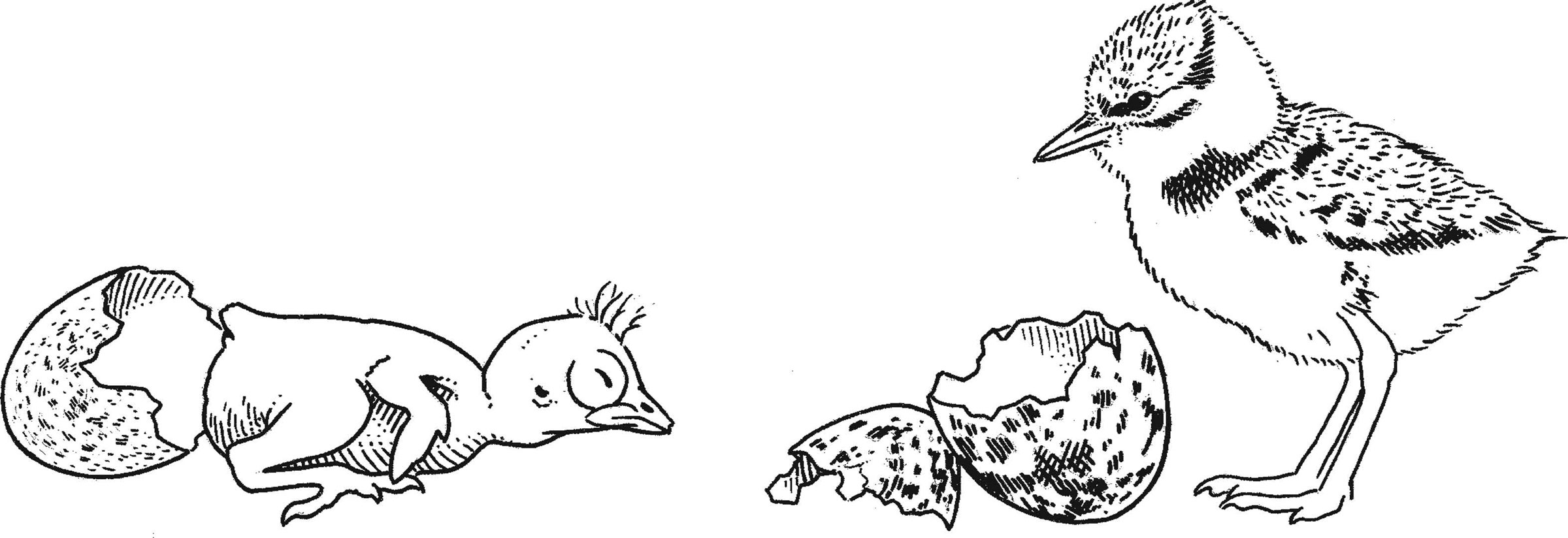
In a broad range of birds from owls to budgerigars, the parents sometimes help their chicks out of the egg by breaking off bits of shell at the bespeak where it is penetrated by the chick'south beak. In other species, the parents help by tipping the chick out of the shell once the cap is removed.
Among those birds that cutting the top off the eggshell, some, like the ostrich, cut through no more than than a quarter of the egg'due south circumference earlier shattering the shell and breaking out. At the other extreme, Barn Owls, pigeons, and quail cut right round the top of the vanquish, neatly removing the entire cap before emerging. The bobwhite quail, which too removes a complete cap, even goes round more than than in one case.
Researchers have speculated about why there should exist such variation in the fashion different bird species sally from the trounce. Ane thought is that hatching might be influenced by the caste of development, with precocial species, like chickens, being stronger and more able to suspension out of the shell than altricial species, similar blackbirds and robins. Simply this idea seemed unlikely equally species with precocial chicks include those that cutting both the smallest (ostrich) and the largest (quail) pipping perforation tracks before emerging. Much more plausible is that eggs whose shell membrane and eggshell are tough and flexible require more cut before the chick can escape than eggs that are hard and breakable. The eggs of ducks and chickens are hard and require only a few pips to destabilise the shell'southward integrity, and chicks can emerge after a relatively few pips. Quail, pigeons and the guillemot, on the other hand, have less brittle, relatively tough eggs and membranes and require more perforations to release the chick.
The final, climax stage of hatching, in which the chick emerges from the crush, varies from a few minutes in small songbirds to a day or more than. In the chicken, the chick punctures the air cell virtually thirty hours before hatching, makes its first pip of the eggshell at twelve hours earlier hatching, and starts to rotate within the shell just fifty minutes before it emerges. In the guillemot, the air prison cell is punctured thirty-five hours before hatching; the first pip appears at twenty-ii hours, and rotation starts nigh five hours before the chick emerges. Besides as the effort required to cutting through the relatively thick vanquish membrane and shell, in that location is another reason for the more protracted process in the guillemot—the chick and its parents have got to be able to recognise each other's voices beforethe chick hatches. Call back that guillemots live beak by jowl with their neighbours at incredible densities and with no nest. They tin recognise their own egg, but they also need to be able to recognise their chick and it may accept a couple of days to complete that process. Soon later on the guillemot chick breaks through into the air cell, it starts to peep, and there is something magical about hearing a guillemot chick inside a still intact egg and its parents calling in response. Their individually distinct calls create a bond between the parents and the chick that ensures they tin can recognise each other the moment the chick breaks free from the beat out. In the closely related razorbill, which breeds in solitary sites away from other razorbills, such immediate parent–offspring recognition does not occur because in that location's no risk that chicks from different families will become mixed up.
I am thrilled past the idea of a guillemot chick inside its egg communicating with its parents. Only in birds producing clutches of eggs that give rise to precocial chicks, something fifty-fifty more remarkable happens. In such species it is important that all the chicks hatch at the aforementioned fourth dimension and can be taken en masse by the mother to safety. Female ducks, for example, minimize delays between the hatching of successive eggs past starting to incubate merely once the entire clutch is complete. Nonetheless, some embryo development occurs fifty-fifty with no, or minimal, incubation, suggesting that the spread of hatching times might still be considerable.
1 of the many novel observations made by Oskar and Magdalena Heinroth was that Mallard ducklings from the same clutch hatched with extraordinary synchrony—over just a two-hour period. Despite this remarkable observation, no one idea much nearly synchronous hatching for a further forty years until some other High german ornithologist, Richard Faust, reported the same phenomenon in convict American rheas. Fifty-fifty though the interval between laying and hatching in different rhea clutches varied from 27 to 41 days, the chicks still hatched over only two or three hours. Faust realised that something must be causing this synchronisation but he did not know what.
Margaret Vince, a researcher in Cambridge during the 1960s, solved the trouble when she discovered that eggs talk to each other. She noticed that if she held a Japanese quail egg close to her ear merely earlier it hatched, she could hear a peculiar clicking noise. This sound is uttered by the chick between 10 and 30 hours after information technology has first pipped the beat and Vince realised that this might be how eggs in the same nest signal to each other and synchronise their activities. To exam her theory she reared bobwhite quail nether different circumstances and found that the eggs must be touching for synchronous hatching to occur, suggesting that the communication is partly auditory and partly tactile. Indeed, when she exposed quail eggs to artificial vibrations or clicks, she could induce synchronous hatching. The chick's clicks could either ho-hum down or speed up the hatching process in adjacent eggs: near remarkable of all, when Vince added an egg to a clutch 24 hours later than the others, it was able to speed up its hatching to such an extent that the chick emerged from the egg at the same fourth dimension as the others.
The chicks of different bird species hatch in various states of development. At one extreme are helpless 'altricial' chicks of vocal-birds; at the other are the completely independent "super-precocial" chicks of the megapodes which hatch fully feathered, their eyes open up and capable of flight. In between, there is the familiar babe craven—eyes open up, covered in down and, although capable of feeding itself, even so dependent upon its mother for protection and care. The guillemot chick is slightly less precocial than this, in that while its eyes are open up and it is covered in down, it cannot run around and it cannot command its ain body temperature. And probably simply also: cliff ledges are no place to be running around, at least not until the chick has some decent coordination and a practiced sense of what an border is—which it acquires equally it grows. Because the guillemot chick is unable to maintain its torso temperature, it requires warming against its parent'southward brood patch, which also helps to go along it safe.
What's left as the chick hatches? The answer is, not much: just the shell, which is slightly thinner than it was when the egg was laid considering the chick has taken some of the calcium to form its skeleton. But the empty shell is a liability: Its sharp edges could hurt the delicate young chick; the chicks could be trapped inside a shell; simply worse, the pale-coloured inside of the shell makes an egg that was one time cryptic highly conspicuous to predators. The parents bargain with these challenges in 1 of two ways: Either they eat the beat or they remove the eggshell from the nest. Well-nigh commonly the parents conduct the ii pieces of eggshell away. Birds like herons, nesting high upwards in trees, only flick the trounce pieces out of the nest; grebes, which nest on water, push the shell pieces out of sight beneath the surface; and ground-nesting birds like gulls pick the pieces up in their neb and fly off before dropping them a few tens of metres away.
In an elegant set of field experiments on nesting Blackness-headed Gulls conducted in the 1950s and 1960s Niko Tinbergen demonstrated both the cues that stimulate eggshell removal and the survival value of eggshell removal behaviour. The cue that triggers removal is the light weight of the empty eggshell; and the survival value is that it removes the white inner beat out that predators similar crows cue in on to find tasty immature chicks. Ducks but get out the eggshells in the nest but remove their synchronously hatched chicks to places where they are safer from predators. Guillemots and other cliff-nesting birds, similar the kittiwake, simply exit the eggshell wherever it is, because their chicks are relatively safety from predators.

The Most Perfect Affair: Inside (and Outside) a Bird's Egg, by Tim Birkhead, Bloomsbury, 288 pages, $20.28. Buy it at Amazon.
Source: https://www.audubon.org/news/the-art-hatching-egg-explained
0 Response to "Update on Baby Whose Head Was Cracked Like an Egg Shell by Father"
Enregistrer un commentaire